|
Orthodoxy: A Treasury of Tradition
The
term “tradition” derives from the Latin traditio, the noun form of
the verb trado, which means “to hand over” or “to hand down.”
The
identical Greek term is παράδοσις (parádosis) which means “to give
over,” or “to hand down,” by word of mouth or in writing.
The
concept behind both words, παράδοσις and traditio, is
absolutely foundational in the Orthodox Faith.
Holy
Tradition is the deposit of faith given by Jesus Christ to the Apostles
and “handed down” in the Church. This Tradition is “the life of the
Holy Spirit in the Church.” It is dynamic in application, yet unchanging
in dogma. It is growing in expression, yet ever the same in essence.
Many
conceptions of tradition in popular understanding, mean something
which grows and expands over time, forming a collection of practices and
doctrines which accrue.
The
Orthodox Church, however, views Holy Tradition as the unchanged faith
passed from Christ to the Apostles and preserved through Apostolic
Succession, not as something gradually expanding and eventually
unrecognizable to the first Christians.
Holy
Tradition is that same faith which Christ taught to the Apostles and which
they gave to their disciples, preserved in the whole Church and especially
in its leadership through Apostolic Succession.
Holy
Holy Tradition in the Bible
Curiously,
as understood by many heterodox (non-Orthodox) Christians, Tradition
stands in contrast to Scripture.
Nonetheless,
there are a number of references in Holy Scripture itself to Holy
Tradition. For example:
-
Many
have taken in hand to set in order a narrative of those things
which have been fulfilled among us, just as those who from the
beginning were eyewitnesses and ministers of the word delivered
them to us, it seemed good to me also, having had perfect
understanding of all things from the very first, to write to you
an orderly account, most excellent Theophilus, that you may know
the certainty of those things in which you were instructed.
Luke 1:1-4
(Note: In this instance, the oral word preceded the written
word. Hence, Holy Tradition.)
-
And
truly Jesus did many other signs in the presence of His disciples,
which are not written in this book; but these are written that you
may believe that Jesus is the Christ, the Son of God, and that
believing you may have life in His name.
John 20:30-31
-
I
wrote to you in my epistle not to [a]keep company with sexually
immoral people. Yet I certainly did not mean with the sexually
immoral people of this world, or with the covetous, or
extortioners, or idolaters, since then you would need to go out of
the world.
1 Corinthians 5:9-10
(Note: Here Paul makes a reference to a letter written to
Corinth before the letter we know today as 1st Corinthians. This
letter is unknown to modern scholars.
-
Now
I praise you, brethren, that you remember me in all things and
keep the traditions just as I delivered them to you.
1 Corinthians 11:2
-
Now
when this epistle is read among you, see that it is read also in
the church of the Laodiceans, and that you likewise read the
epistle from Laodicea.
Colossians 4:16 (Note: The “epistle from Laodicea” is not available to us today is written form.)
-
Therefore,
brethren, stand fast and hold the traditions which you were
taught, whether by word or our epistle.
2 Thessalonians 2:15
-
But
we command you, brethren, in the name of our Lord Jesus Christ,
that you withdraw from every brother who walks disorderly and not
according to the tradition which [a]he received from us.
2 Thessalonians 3:6
Liturgical Tradition
The
Orthodox Church today is an invaluable treasury of the rich liturgical
tradition handed down from the earliest centuries of Christianity.
The
sense of the sacred, the beauty and grandeur of the Orthodox Divine
Liturgy, make the presence of heaven on earth alive, experiential, and
intensive.
Orthodox
Church art and music has a very functional role in the liturgical life
and helps even the five bodily senses participate in, and experience,
the spiritual grandeur of the Lord’s mysteries.
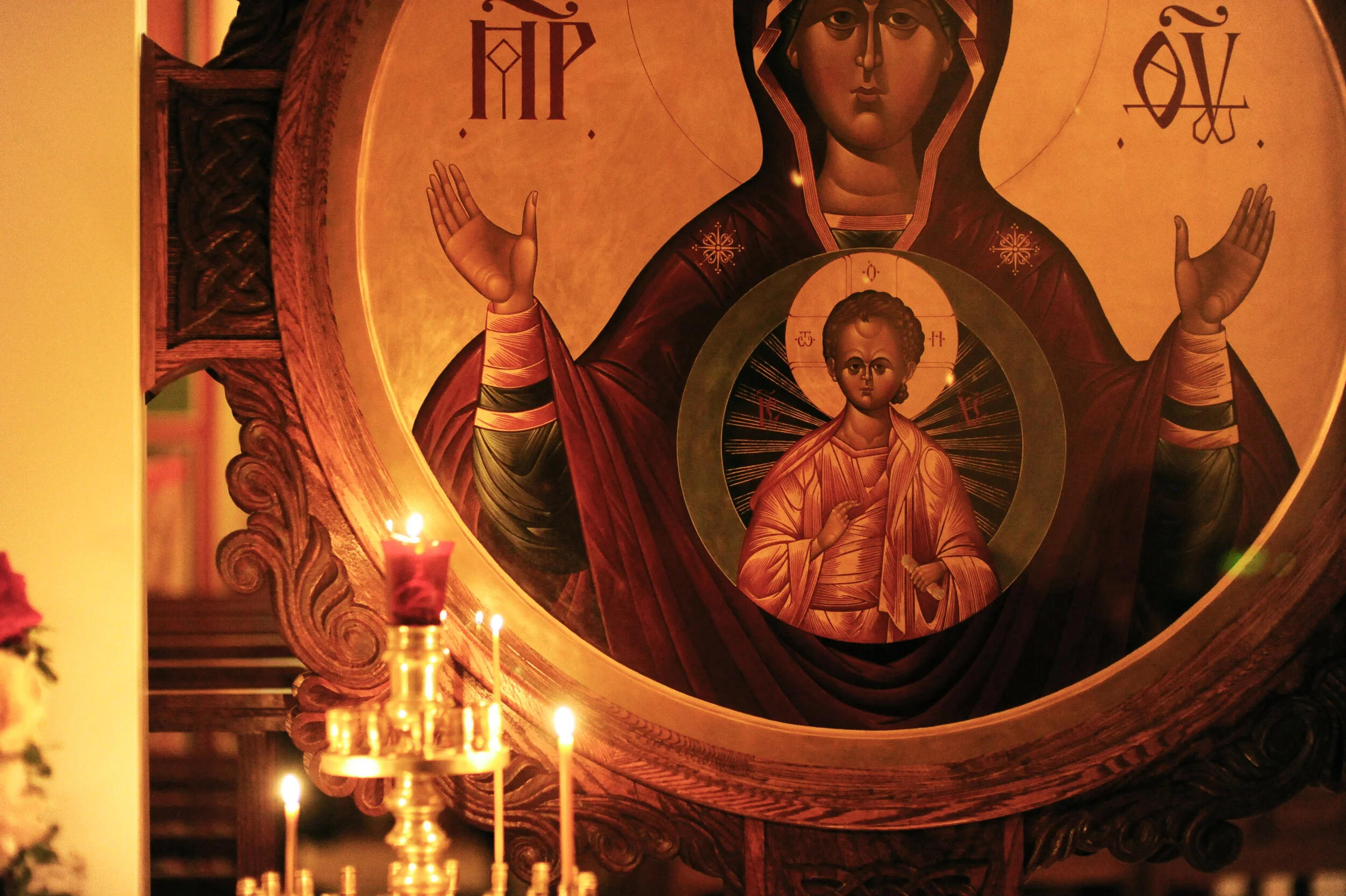
Orthodox
icons are not simply beautiful works of art which have certain
aesthetic and didactic functions. They are primarily the means through
which we experience the reality of the Heavenly Kingdom on earth.
The
holy icons enshrine the immeasurable depth of the mystery of Christ’s
incarnation in defense of which thousands of martyrs sacrificed their
lives.
The
Orthodox liturgical tradition purposefully and deliberately involves all
five senses during its worship services, recognizing that human beings are
holistic creatures who experience and express their faith through various
sensory channels. This multi-sensory approach helps worshippers to enter
into a deeper and more profound encounter with the Divine during the
sacred act of worship.
Sight
Orthodox
churches are rich in visual symbolism. Icons, depicting Christ, the Virgin
Mary, saints, and biblical scenes, adorn the walls. These icons serve as
windows into the heavenly realm, aiding worshippers in focusing their
thoughts on spiritual matters. The architecture of Orthodox churches often
includes elements like domes, iconostases (icon screens), and candle-lit
interiors, all contributing to a visually immersive worship experience.
Hearing
The
Divine Liturgy involves a rich array of sounds, including chanting,
singing, prayers, and Scripture readings. The chanting of hymns and
Psalms, often performed a capella, creates an atmosphere conducive to
prayer and meditation. The prayers and Scripture readings are essential
auditory elements of the service, conveying the Word of God to the
worshippers.
Smell
Incense
has a prominent role in Orthodox worship, as its use of incense dates back
to the Old Testament times and is deeply rooted in the tradition of the
Church. The sweet aroma of incense is used represents the prayers of the
faithful rising up to God and being favorably received by Him. Filling the
air during the services, it creates a sense of sacredness and reverence.
Taste
The
central act of worship in the Orthodox Liturgy is the Eucharist, or Holy
Communion, where worshippers partake of bread and wine, which we believe has become
the Body and Blood of Christ. This act engages the sense of taste in a
profound way, as believers receive the Sacrament with reverence and faith,
understanding it as participation in the divine life of Christ.
Touch
Worshippers
engage in various physical acts of reverence and participation during the
service. This includes crossing themselves, standing, bowing, kneeling,
and venerating (kissing) icons and other sacred objects. The physical
movements and gestures involve the whole person, connecting the body and
the soul in prayer and worship.
|