|
The Great Schism
The
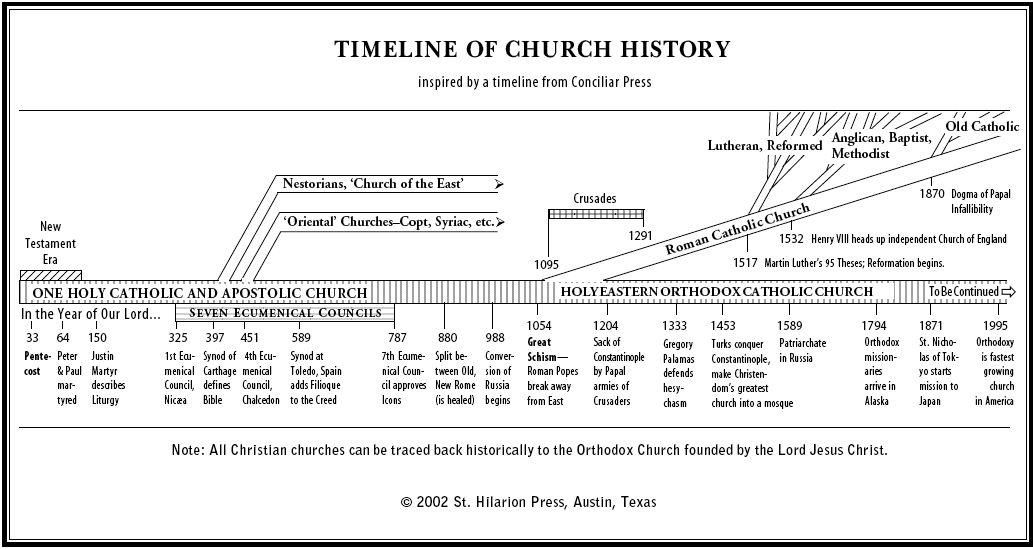
Great Schism between the Eastern and the Western Church (nominally
dated as occurring in AD 1054) was the culmination of a gradual
process of estrangement between the east and west that began in the
first centuries of the Christian Era and continued through the Middle
Ages. Linguistic and cultural differences, as well as political
events, contributed to the estrangement.

From
the 4th to the 11th century, Constantinople, the center of Eastern
Christianity, was also the capital of the Eastern Roman, or Byzantine,
Empire, while Rome, after the barbarian invasions, fell under the
influence of the Holy Roman Empire of the West, a political rival.
Theology in the West remained under the influence of Saint Augustine
of Hippo (AD 354-430) and gradually lost its immediate contact with
the rich theological tradition of the Christian East.
Most
significantly, the Roman See was almost completely overtaken by the
Franks who also began reformulating the theology of Western
Christendom. Concurrently, the Orthodox East was increasingly
subjugated by the followers of Islam which, while making life very
difficult, allowed the Orthodox Church to fervently and faithfully
maintain its theology unchanged and unaffected.
Theological
differences might possibly have been settled if there had not been two
different concepts of church authority. On the one hand, the concept
of a Roman primacy developed, based on the concept of the Apostolic
origin of the Church of Rome which claimed not only titular but also
jurisdictional authority above other churches, and was incompatible
with the traditional ecclesiology of the historical Christian Church.
On
the other hand, the Eastern Christians considered all churches as
sister churches and understood the primacy of the Roman bishop only as
primus inter pares among his brother bishops. For the East, the
highest authority in settling doctrinal disputes could by no means be
the authority of a single Church or a single bishop but an Ecumenical
Council of all sister churches.
Over
the course of time the Church of Rome also adopted various new
doctrines, and even proclaimed certain new dogmas, which were not part
of the Tradition of the undivided Christian Church of the first
millennium. The Protestant Reformation of the fifteenth century
further fractured Western Christian theology and ecclesiology, to the
extent that at the beginning of the twenty-first century there are
estimated to be over 30,000 independent Protestant denominations.
The
Roman Catholic proclamation by Pius IX in 1870 of papal infallibility
as dogma, further widened the ecclesiological differences between the
Christian East and West. The Protestant communities which split from
Rome have also diverged significantly from the Christological and
soteriological teaching of the Holy Fathers and the Holy Ecumenical
Councils of the first millennium. Due to all of these serious dogmatic
differences, the Orthodox Church cannot be in communion with the Roman
Catholic Church and/or her Protestant denominations.
|


 ,
,