|
Orthodoxy and the Various Christian Denominations
Academic Objective Perspective
It
can be stated academically and objectively that the Orthodox Church today
maintains and continues the faith and practices of first-century and
first-millennium Christianity.
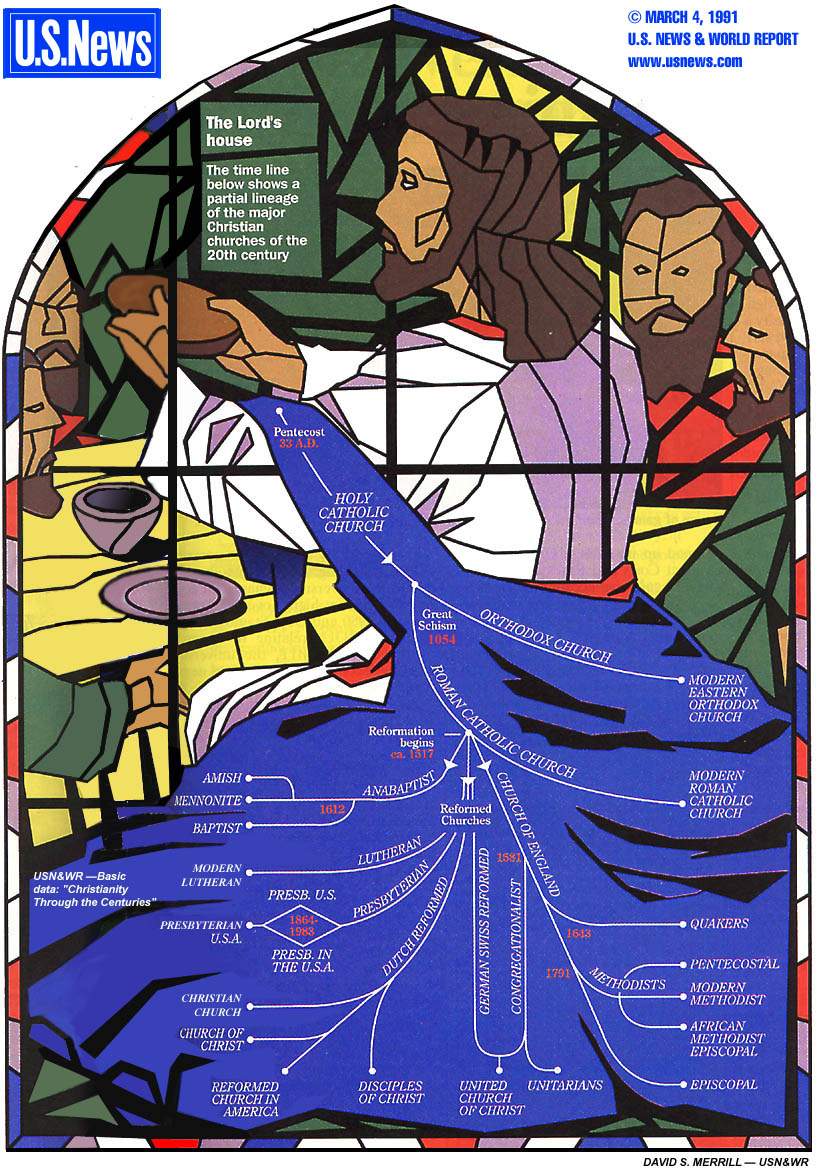
It
can also be stated academically and objectively that the Roman Catholic
Church held that same faith and practices during the first-millennium, and
that it began to evolve beyond these in the ninth century.
It
can likewise be stated academically and objectively that the Protestant
Church denominations began to evolve beyond the faith and practices of the
Roman Catholic Church in the sixteenth century.
Orthodox perspective
From
the perspective of the Orthodox Church it would appear that Western
Christendom is comprised of the Roman Catholic Church and her Protestant
denominations which differ from itself and thus from the faith and
practices of the Christian Church during the first millennium.
Roman Catholic perspective
From
the perspective of the Roman Catholic Church it would appear that Eastern
Orthodox Christendom continues to maintain the faith and practices
of the first millennium and, moreover, that the Orthodox Church is an
inherent part of itself.
This
Roman Catholic point of view is explicitly declared in its Second Vatican
Council Decree On Ecumenism, Unitatis Redintegratio. Under the
sub-heading, The Special Consideration of the Eastern Churches, the
Decree states “These (Orthodox) Churches, although separated from us,
possess true sacraments, above all by Apostolic succession, the priesthood
and the Eucharist, whereby they are linked with us in closest
intimacy.
“Different” does not imply “judgment” or “condemnation”
Nevertheless,
from the Orthodox standpoint, the Roman Catholic Church and its Protestant
Denominations are neither the same as, nor part of, itself. They are
different and separate from the Orthodox Church.
Note
clearly that what has been said above is in no way a judgement or
condemnation. It is simply a recognition that the theology of the Orthodox
Church is not the same as the theologies of the Roman Catholic and
Protestant Churches.
It
is a matter of theological opinion and perspective whether the changes and
differences in theology – especially concerning Christology, Soteriology,
and Ecclesiology – as well as in faith practices expressed by the Roman
Catholic Church, and even moreso by her Protestant denominations, are
“correct” or otherwise.
Nevertheless,
Roman Catholic and Protestsant theologies differ from that of the first
thousand years of undivided Christianity. They are different from the
consistent, 2,000-year tradition of Orthodox theology.
Orthodox and Heterodox
The
word “orthodox” is used to indicate “right belief” and “right worship” and
also implies “correct” belief and worship. The “Orthodox” Church
understands “Orthodoxy” to be the consistent continuance of the “Apostolic
Faith” – by which is meant that which was taught by Christ, preached by
the Apostles, and faithfully maintained by the Tradition of the Church.
The
Roman Catholic Church and her Protestant Denominations are regarded by the
Orthodox Church as “heterodox.” This merely means that their beliefs
differ from the beliefs, teachings, and practices of its own. In other
words, “Orthodox” indicates adherence to traditional doctrines whereas
“heterodox” means change from that tradition.
No
judgement is intended by defining Roman Catholic and Protestant beliefs as
heterodox, it simply means that they differ from those of Orthodox
Christianity.
|


 ,
,